As an Amazon Associate this site earns from qualifying purchases.
Specifications at a glance
| Product | Price | Dimensions (W × D × H) | Drawers / open storage | Lighting | Power | Seat included |
|---|---|---|---|---|---|---|
| LIVELYGLOW White Makeup Vanity Desk with Charging Station & 4 Drawers | Check price on Amazon | 34.1" × 15.7" × 53.9" | 1 large + 3 side drawers, multi-layer open shelves | Touch LED mirror, 3 modes (warm yellow / natural white / cool white), stepless dimming | 2 AC outlets, 2 USB | Cushioned stool |
| Quimoo Large Vanity Desk with LED Lighted Mirror & Power Outlet | Check price on Amazon | 42.1" × 15.7" × 55.5" | 7 drawers, 6 open spaces, 5 hooks | HD mirror, 3 color modes, brightness switch | 2 outlets, 2 USB | Not stated |
| SONGMICS HOME Vanity Desk with Mirror and Lights, 9 Drawers | Check price on Amazon | Not stated | 9 drawers, 8 open compartments | 9 bulbs around mirror, adjustable brightness | 2 AC, 1 USB-A, 1 USB-C | Not stated |
| LIVELYGLOW 35.4" Wooden Makeup Vanity Set with Charging Station & Stool | Check price on Amazon | 35.4" × 15.7" × 53.9" | 1 large + 3 fluted side drawers, multi-layer shelves | Touch LED mirror, 3 modes, stepless dimming | 2 AC, 1 USB, 1 Type-C | Cushioned stool |
| LIVELYGLOW 43" Large White Makeup Vanity Desk with Charging Station | Check price on Amazon | 43.3" × 15.7" × height not stated | 7 drawers (6 small, 1 large), 4 open shelves | Smart LED mirror, 3 color modes, stepless dimming | Built-in outlet (count not stated) | Not stated |
| COMHOMA Makeup Vanity Desk with Mirror and Lights, 5 Drawers | Check price on Amazon | Not stated | 5 drawers | Surrounding bulbs, 3 color modes, adjustable brightness | 2 outlets, 2 USB | Chair (table and chair set) |
Quick answer: A makeup vanity is mostly a lighting-and-storage decision, not a furniture decision — you want a mirror with adjustable color temperature, drawers deep enough for tall bottles, and outlets built into the desk so your hair dryer isn't running across the floor. Almost every vanity in this price range (roughly $110–$165) hits those three notes; the real differences are width, drawer count, and whether a stool is included. Measure your wall first, then pick the widest unit that fits, because desktop space is the thing people run out of.
Where a spec says "Not stated," it isn't in the listing data — confirm it on the product page rather than assuming.
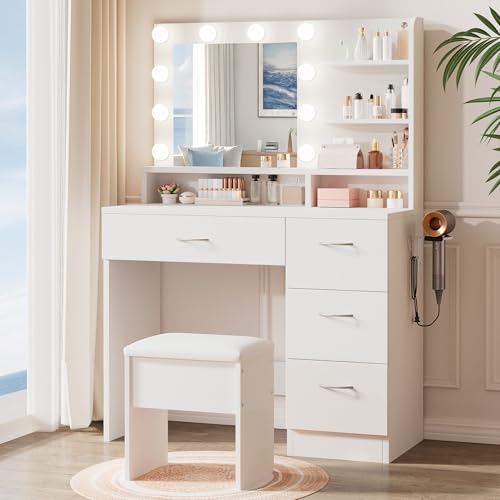
- HD Mirror & 10 Hollywood LED Bulbs Elevate your beauty routine with an HD Mirror and 10 dimmable LED bulbs. Switch between 3 color modes (Warm/Natural/Cool) to ensure flawless
- Built-in Charging Station & Tool Rack Stay powered with a built-in power strip featuring 2 AC outlets and 2 USB ports. Charge your phone and use hair tools like dryers or curlers
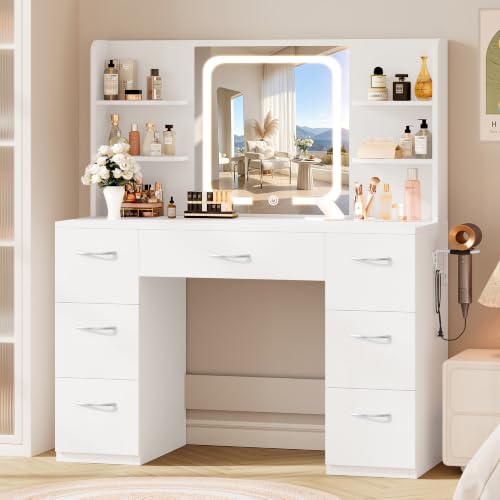
- 【Smart LED Mirror & Power Station】Makeup vanity with built-in power outlet & hairdryer rack. Features Smart LED Mirror with 3 color modes & stepless dimming for perfect lighting
- 【Large Storage with 7 Drawers】Dressing table features 7 drawers (6 small, 1 large) & 4 open shelves. Scientific layout organizes cosmetics, jewelry & skincare, maximizing storage
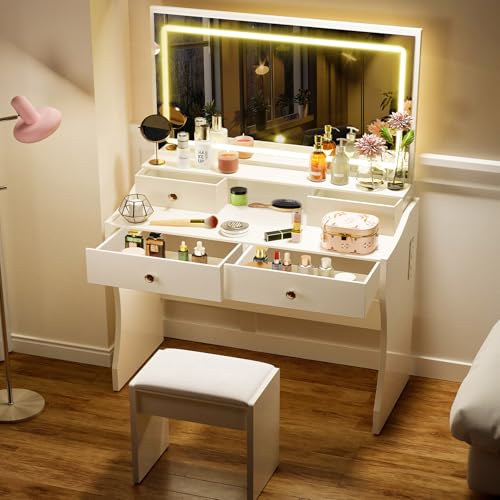
- Vanity Desk with Large Mirror - Our upgraded white makeup vanity features a wider rectangular mirror, providing a more comprehensive and complete field of view. The surrounded
- Vanity with Large Storage Capacity - 5 Drawers of different sizes for you to store different types of belongs. What's special is the thickened top, which allows you to put some
The reference point, and what the category actually gives you
LIVELYGLOW White Makeup Vanity Desk with Charging Station & 4 Drawers — the baseline configuration
The LIVELYGLOW White Makeup Vanity Desk with Charging Station & 4 Drawers at $139.99 is a good yardstick because it has the exact feature set the whole category converges on: a touch-sensitive LED mirror with warm yellow, natural white and cool white modes plus stepless dimming; a built-in power strip with 2 AC outlets and 2 USB ports; a side-mounted hairdryer rack; and 1 large plus 3 side drawers with open shelving on the desktop. At 34.1"W × 15.7"D × 53.9"H it's on the compact end. The listing describes the surface as waterproof and wear-resistant, and a cushioned stool is included.
The best makeup vanity buying guide for your situation depends on how you plan to use it and where.
Use those numbers as your comparison baseline. If another vanity costs more, it should be buying you width, drawers, or a finish you actually want — not just a different sticker.
Who a vanity like this is for
- You do makeup sitting down, daily. The three-color lighting is the whole point. Cool white for precision, warm yellow to preview how a look reads under restaurant lighting.
- Your outlets are inconveniently placed. A built-in power strip at desk height genuinely changes the routine — hair dryer, curling iron and phone all plug in where you sit.
- You own a lot of small things. Six to nine drawers plus open shelves swallows an embarrassing amount of product.
- You're furnishing a bedroom corner, not a bathroom. These are 15.7" deep and 53.9"–55.5" tall with the mirror — they want a bedroom or dressing-room wall.
- You're okay assembling flat-pack furniture. All of these ship in pieces.
Who should skip it
- You need it in a wet bathroom. These are bedroom dressing tables with plug strips, not plumbed bathroom vanities. Steam and standing water are not what they're built for.
- You stand to do makeup. A 53.9"-tall unit with the mirror mounted low is designed for a seated user.
- You have less than about 36" of clear wall. The narrowest here is 34.1" wide; the widest is 43.3". None of them shrink.
- You want heirloom furniture. At $110–$165 you're getting engineered-wood construction with printed finishes. It'll look good and it'll do the job, but it is not solid oak.
- You need a stool and won't buy one separately. Only some of these state that a seat is included.
Honest trade-offs
Drawer count vs. drawer size. The SONGMICS unit lists 9 drawers, the Quimoo 7 — but more drawers in a fixed footprint means each one is smaller. If you store tall serum bottles and hair tools, a couple of deep drawers plus open shelving may serve you better than a grid of shallow ones.
LED strip mirror vs. bulb-style mirror. The LIVELYGLOW units use a touch-sensitive LED panel mirror with stepless dimming; the SONGMICS and COMHOMA use bulbs around the frame. Bulbs give you that dressing-room look; a diffused LED panel tends to be flatter and less harsh. Both are listed as adjustable — it's a preference, not a quality gap.
Built-in power is convenient and also a commitment. A vanity with an integrated strip has to live near an outlet, and if the strip ever fails you're dealing with the manufacturer, not just swapping a $15 power bar.
Assembly. Every listing here promotes labeled parts and clear instructions; SONGMICS specifically calls out snap-in drawer slides that click in without screws. Assume an hour or two regardless, and assume you'll want a second person for the mirror.
Waterproof means wipe-clean. LIVELYGLOW describes its surfaces as waterproof and wear-resistant. Read that as "foundation spills wipe off," not "leave it in a steamy bathroom."
What to check on the listing before you buy
Listings change constantly, so verify these yourself rather than trusting any article, including this one:
- Current price. Every figure above is a snapshot. Prices on this category move a lot.
- The variant you're clicking. Color and size options often live under the same listing at different prices. White, wooden, and different widths are frequently separate variants — confirm the one in your cart matches the dimensions you measured for.
- Whether a stool or chair is actually included. Two of these explicitly include seating; for the others it isn't stated. Check the images and the "what's in the box" section.
- Exact dimensions and mirror height. For the units above where height or full dimensions aren't stated, get them from the listing before you commit. Also check knee clearance — Quimoo states 25.6" from drawer bottom to floor, which is the kind of number that decides whether your chair fits.
- Outlet and port configuration. USB-A vs. USB-C matters if you're charging a modern phone. The SONGMICS lists both; others list USB-A only or don't specify.
- Warranty and return window. LIVELYGLOW's 43" listing references a warranty; the others reference customer support rather than specific terms. Read the current warranty text on the page.
- Reviews. Go read them yourself, sorted by most recent and filtered to your variant. Pay attention to comments about the light unit and the power strip specifically — those are the parts that fail.
Consider these instead
Quimoo Large Vanity Desk with LED Lighted Mirror & Power Outlet — consider instead if…
…you want maximum storage in a tall footprint. The Quimoo Large Vanity Desk with LED Lighted Mirror & Power Outlet, Makeup Vanity Table with 7 Drawers, 4 Shelves and 5 Hooks is 42.1"W × 15.7"D × 55.5"H with 7 drawers, 6 open storage spaces and 5 hooks on the upper-left shelf for necklaces and bracelets. It's the priciest here at $163.99, and it's the only one that doubles as jewelry storage in a meaningful way.
SONGMICS HOME Vanity Desk with Mirror and Lights — consider instead if…
…drawer count is your deciding factor and you like a handleless look. The SONGMICS HOME Vanity Desk with Mirror and Lights, Makeup Vanity Table with Power Outlets, 9 Drawers lists 9 drawers plus 8 open compartments, 9 bulbs around the mirror with adjustable brightness, and the most modern port setup of the group — 2 AC outlets, 1 USB-A and 1 USB-C. The snap-in drawer slides are a real assembly time-saver. Dimensions aren't stated, so measure from the listing.
LIVELYGLOW 35.4" Wooden Makeup Vanity Set with Charging Station & Stool — consider instead if…
…white lacquer doesn't match your room. The LIVELYGLOW 35.4" Wooden Makeup Vanity Set with Charging Station & Stool is the same basic layout as the white 34.1" model — 1 large plus 3 side drawers, LED mirror with 3 modes and stepless dimming, hairdryer rack, cushioned stool — in a wood-grain finish with fluted drawer fronts, at 35.4"W × 15.7"D × 53.9"H for $159.99. It also swaps in a USB-C port alongside the USB-A.
LIVELYGLOW 43" Large White Makeup Vanity Desk with Charging Station — consider instead if…
…desktop surface area is what you're short on. The LIVELYGLOW 43" Large White Makeup Vanity Desk with Charging Station is the widest option at 43.3"W × 15.7"D, with 7 drawers (6 small, 1 large), 4 open shelves, and the same smart LED mirror with 3 color modes and stepless dimming, for $159.99. The listing emphasizes leg room and a large desktop — worth a look if you also want to use it as a desk.
COMHOMA Makeup Vanity Desk with Mirror and Lights — consider instead if…
…you want the lowest entry price with a seat included. The COMHOMA Makeup Vanity Desk with Mirror and Lights, Vanity Table and Chair Set with 5 Drawers & Charging Station is $109.98 and ships as a table-and-chair set, with a wide rectangular mirror, 3 color modes with adjustable brightness, 2 outlets and 2 USB ports, 5 drawers of varying sizes, crystal-inspired knobs and a thickened top. Fewer drawers than the rest — the trade you make for the price.
FAQ
Can I put one of these in my bathroom? They'll physically fit, but they're bedroom dressing tables. The finishes are described as waterproof and wipe-clean, which is about spills, not sustained humidity — and each one has a built-in power strip, which you don't want near a shower. A plumbed bathroom vanity is a different product.
Which lighting mode should I actually use? Match your destination. Cool white is closest to daylight and shows blending flaws, which is what you want for daytime looks. Warm yellow previews how a look reads under indoor evening lighting. Every vanity here offers both plus an in-between white, and all of them let you dim.
Do I need the built-in outlets, or is a power strip fine? A regular power strip works. The built-in version is about not having a cord snake across the floor and having the hairdryer rack right there. It's convenience, not capability — worth paying for if your nearest outlet is awkward, less so if it's already behind the desk.
How much wall space do I really need? Add at least a few inches to the stated width so drawers and the stool have room, and check ceiling-adjacent obstacles like a window sill or sloped ceiling against the 53.9"–55.5" heights. Also check knee clearance under the desktop before you commit to a chair you already own.
Related guides
- Best bathroom fixtures and vanities - bathroom vanities, bidets, vanity tables and makeup vanities with Past Challenges
- Best bathroom fixtures and vanities - bathroom vanities, bidets, vanity tables and makeup vanities After Recent Issues
- Terms and Conditions
Key Takeaways
- Choosing the right makeup vanity buying guide means matching the key features to your specific needs and budget
- Read real customer reviews and check the return policy before you commit
- Compare value across models — the priciest option is not always the best fit