What goes wrong, and how to fix it
| Failure | Symptom | Fix |
|---|---|---|
| Measured the wall, not the opening | Vanity arrives and the door won't close past it | Re-measure with the bathroom door open at 90°; drop one size class |
| Ignored the "nominal" vs actual width | 36" vanity won't slide into a 36" alcove | Always read the listed assembled dimensions, not the model name |
| Drain height outside the vanity's window | Cabinet won't sit flat against the wall | Cut a relief notch in the back panel, or choose a vanity with an open under-sink area |
| Faucet holes don't match the faucet | Faucet base leaves gaps or won't seat | Buy the top first, then match the faucet to its stated hole spacing |
| Forgot drawer clearance in a narrow room | Drawer hits the toilet or opposite wall | Switch to a sliding-door or door-front design |
| Height changed but the mirror didn't | Backsplash crowds the mirror frame | Rehang the mirror; leave 5–8" between top of backsplash and mirror bottom |
Quick answer: Measure the wall opening first, then subtract clearance — you need at least 4 inches of side clearance on each side to a wall and about 21 inches of open floor in front of the vanity. Most bathrooms land on a 24", 30", 36", or 48" width, and the deciding factor is usually your door swing and drain position, not the wall length. Standard depth is 18–19 inches and modern heights run 33.5"–35", so check the height against your existing mirror before you order anything.
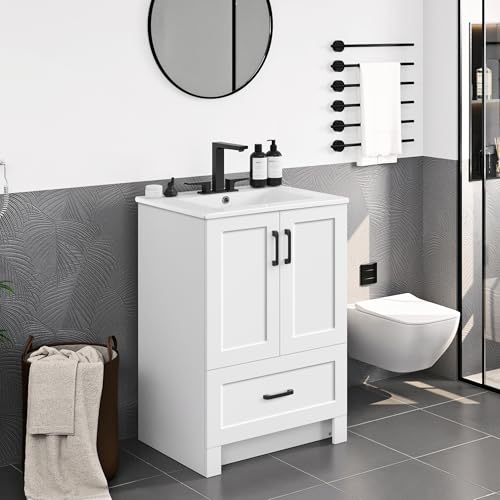
- Specifications: Color: White; Materials: Ceramic Basin, MDF,Metal Hardware; Assembled Dimensions: 24.5″ L × 18.5″ W × 34″ H; Maximum WeightCapacity: Ceramic Basin: 66 lb; Shelf
- Large Storage Space: Tidy up your bathroom and utilizethe storage space beneath the bathroom vanity to maintain cleanliness. Theample space under the sink cabinet offers
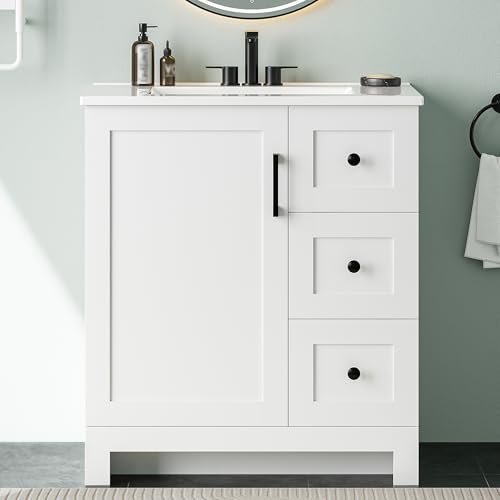
- Modern Matte Vanity: This vanity showcases a crisp matte white finish with clean lines. Its sealed base keeps dust out, while the ergonomic 3-inch toe-kick enhances comfort
- Smart Storage System: The vanity features a soft-close door with adjustable hinges, offering a spacious cabinet interior. It includes one shallow drawer and one deep drawer, each
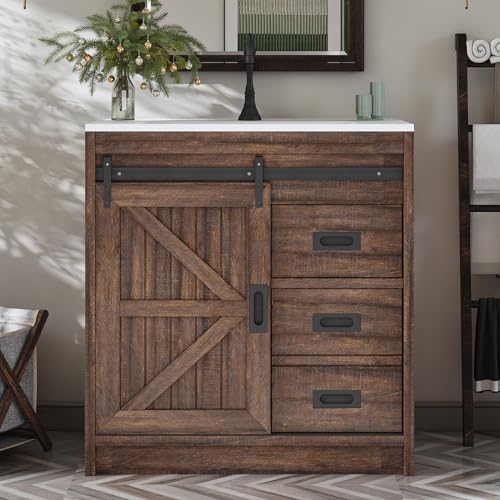
- 【Integrated Sink】Bathroom vanity with an integrated sink that is easy to clean without dead corners, features an overflow, and a deep basin that prevents water from splashing and
- 【Sliding Barn Door Design】 Bathroom vanity features a sliding barn door that opens to reveal storage space and two independent drawers, perfect for keeping your bathroom
The measuring checklist, in order
Work through these in sequence. Skipping ahead is how people end up with a vanity that technically fits and functionally doesn't.
1. Measure the wall at three heights. Floor level, counter level (about 34"), and top of the intended vanity. Old bathrooms are rarely square, and tile buildup at the base can steal a half-inch. Gotcha: use the smallest of the three numbers as your true opening, not the widest.
Finding the right how to choose bathroom vanity size comes down to matching the features to how you will actually use it.
2. Subtract your clearance. If the vanity butts into a side wall, give it 2–4 inches so the drawer fronts and door handles clear the baseboard and so a caulk line is possible. If it sits between two walls, subtract on both sides. Gotcha: a 36" opening does not take a 37"-wide vanity — the DELUXE LIVING 36 Inch model is 37" wide despite the name, which is exactly the kind of mismatch that gets a delivery sent back.
3. Check the door swing. Open your bathroom door and mark where the leading edge lands on the floor. Then check the vanity's own doors and drawer extension. A 36" vanity with two swing doors needs roughly 20 inches of clear pull-out space; a sliding barn door design needs almost none. Gotcha: the entry door and the vanity door often want the same square foot of air.
4. Measure the plumbing rough-in height. Measure from the finished floor to the center of your wall drain and to the water inlets. Vanities have a working window here — the Yaheetech 24" model, for instance, specifies that this height needs to fall between 18.3 and 26.4 inches. If your drain sits above the vanity's cabinet floor cutout, you're doing surgery on the back panel.
5. Decide on depth. 18 inches is the default. In a bathroom narrower than 60 inches, that depth plus the door swing plus a human body gets tight fast. Gotcha: depth specs sometimes include the countertop overhang and sometimes don't — the LIKIMIO 36" lists 18.3" D while the DELUXE LIVING lists 19" D. That 0.7" matters in a hallway bath.
6. Match height to the users. 34" is the current comfort standard. Taller runs exist — the LIKIMIO 36" is 35" H — and shorter ones too, like the LUXOAK 30" at 33.66" H. Gotcha: raising vanity height raises the faucet, which changes where your existing mirror should hang.
7. Confirm faucet hole spacing before you buy the faucet. Three holes on 4" centers is the most common configuration. Some tops are drilled for a single hole. Buying an 8" widespread faucet for a 4" centerset top is a very common and very annoying mistake.
Spec and compatibility table
| Product | Width | Depth | Height | Sink material | Faucet holes | Price |
|---|---|---|---|---|---|---|
| Yaheetech 24" Bathroom Vanity with Sink, 2 Doors & 1 Drawer Cabinet, White | 24.5" | 18.5" | 34" | Ceramic | 3 holes, 4" centerset | Check price on Amazon |
| LIKIMIO 30" Bathroom Vanity with Sink, 2 Soft-Close Drawers & 1 Door, White | 30" | 18" | 34" | Ceramic | Three 4" centerset holes | Check price on Amazon |
| LIKIMIO 36" Bathroom Vanity with Sink, 1 U-Shaped Drawer & 2 Doors, White | 36" | 18.3" | 35" | Ceramic | Three 4" centerset holes | Check price on Amazon |
| DELUXE LIVING 36 Inch Bathroom Vanity with Sink, Black Single Sink Bathroom Vanity with Integral Top, Modern Bathroom Sink Cabinet with Soft-Closing Doors & Drawers, Adjustable Feet | 37" | 19" | 34.5" | Solid surface composite | Pre-drilled single-hole; 4" and 8" locations provided | See the product list on this page |
| LUXOAK 30" Farmhouse Sliding Barn Door Vanity with Sink Cabinet | 29.3" | 18.31" | 33.66" | Integrated basin | Not stated | Check price on Amazon |
| AMERLIFE 48" Farmhouse Freestanding Vanity with Sink and Deep Basin | Not stated | Not stated | Not stated | Integrated sink, acrylic top | Not stated | See the product list on this page |
When the fix is a new one
Sometimes the measurement exercise ends with "nothing here fits the space." Here's what changes at each size class. Check current listings and read the review section yourself before committing — availability and finish options move around.
Yaheetech 24" Bathroom Vanity with Sink, 2 Doors & 1 Drawer Cabinet, White — the powder-room floor
At 24.5" L × 18.5" W × 34" H, this is roughly the narrowest a full vanity gets before you're into pedestal territory. It's worth noting the stated load limits: 66 lb on the ceramic basin, 66 lb on the shelf, 44 lb in the drawer. The listing also spells out the plumbing window — wall drain and inlet between 18.3" and 26.4" from the floor — which is the single most useful number to check before ordering. Yaheetech 24" Bathroom Vanity with Sink, 2 Doors & 1 Drawer Cabinet, White runs $149.99.
LIKIMIO 30" Bathroom Vanity with Sink, 2 Soft-Close Drawers & 1 Door, White — the 30" standard with a toe-kick
Exactly 30" W × 18" D × 34" H, which is the size most secondary bathrooms are framed around. The 3-inch toe-kick is the detail worth caring about: it lets you stand closer to the basin without your toes hitting the cabinet, which effectively buys back an inch of usable depth. One shallow drawer plus one deep drawer plus a soft-close door. Assembly is self-install, stated at 1–2 hours. LIKIMIO 30" Bathroom Vanity with Sink, 2 Soft-Close Drawers & 1 Door, White is $205.19.
LIKIMIO 36" Bathroom Vanity with Sink, 1 U-Shaped Drawer & 2 Doors, White — 36" at a taller 35" height
36" W × 18.3" D × 35" H. That extra inch of height over the 30" model is a real ergonomic difference if you're tall — and a real problem if your mirror is already hung. The U-shaped drawer routes around the P-trap, which is why it holds more than a standard tip-out front. LIKIMIO 36" Bathroom Vanity with Sink, 1 U-Shaped Drawer & 2 Doors, White lists at $260.21.
DELUXE LIVING 36 Inch Bathroom Vanity with Sink, Black Single Sink Bathroom Vanity with Integral Top, Modern Bathroom Sink Cabinet with Soft-Closing Doors & Drawers, Adjustable Feet — flexible faucet drilling and a dark finish
This answers the "how do I size a black vanity" question directly: same rules, but read the actual dimensions — 37" W × 19" D × 34.5" H, so it's wider and deeper than its 36" label implies. The solid surface composite top ships pre-drilled for a single-hole faucet with 4" and 8" hole locations marked and a drill bit included, which means you're not locked into one faucet style. Adjustable feet help on an out-of-level tile floor. DELUXE LIVING 36 Inch Bathroom Vanity with Sink, Black Single Sink Bathroom Vanity with Integral Top, Modern Bathroom Sink Cabinet with Soft-Closing Doors & Drawers, Adjustable Feet is $294.99.
LUXOAK 30" Farmhouse Sliding Barn Door Vanity with Sink Cabinet — no door swing to plan around
18.31" D × 29.3" W × 33.66" H. The sliding barn door is the reason to look here: in a bathroom where the entry door or toilet crowds the vanity front, a slider removes the swing arc from your clearance math entirely. Two independent drawers sit alongside. It also includes an anti-tip device. LUXOAK 30" Farmhouse Sliding Barn Door Vanity with Sink Cabinet is $239.99.
AMERLIFE 48" Farmhouse Freestanding Vanity with Sink and Deep Basin — the step up to a 48" footprint
A 48" single-sink layout gives you counter space on both sides of the basin, which is the practical upgrade over 36". Sliding barn doors again, plus four sliding drawers and partitioned storage sized for taller bottles. The top is high-strength acrylic over an MDF cabinet, and it ships in two packages — worth knowing if you're carrying it up stairs. Exact dimensions aren't stated in the listing detail, so confirm them on the product page against your measured opening. AMERLIFE 48" Farmhouse Freestanding Vanity with Sink and Deep Basin is $449.99.
FAQ
What are the standard bathroom vanity sizes? Common widths are 24", 30", 36", 48", and 60"+ for doubles. Depth is nearly always 18–19 inches. Height has drifted upward over the years; 34" is typical now, with some models at 35".
How much clearance do I need in front of a vanity? Plan on about 21 inches of clear floor in front as a working minimum, and more if the vanity has swing doors that need to open fully. If you can't get that, a sliding-door cabinet solves the problem without shrinking the vanity.
Can I put a 36" vanity in a 36" space? Usually no. Check the assembled width, not the model name — some 36" vanities measure 37" wide. You also want a small gap for caulk and for the doors to clear adjacent trim.
Does vanity height need to match my existing mirror? Not exactly, but changing the height by an inch or more shifts the faucet and backsplash, so the mirror will likely need rehanging. Decide on height before you touch the wall.
Related guides
- Best Bathroom Vanities for Small Bathrooms
- TOTO Washlet C5 Review: Is It the Right Bidet Seat?
- Alternative Options for Best bathroom fixtures and vanities - bathroom vanities, bidets, vanity tables and makeup vanities
Key Takeaways
- Choosing the right how to choose bathroom vanity size means matching the key features to your specific needs and budget
- Read real customer reviews and check the return policy before you commit
- Compare value across models — the priciest option is not always the best fit